Flow simulation
Set up and run finite-element and finite-volume simulations, with attention to meshes, boundary conditions, and convergence.

Computational fluid dynamics research, simulation pipelines, and physics-guided machine learning.
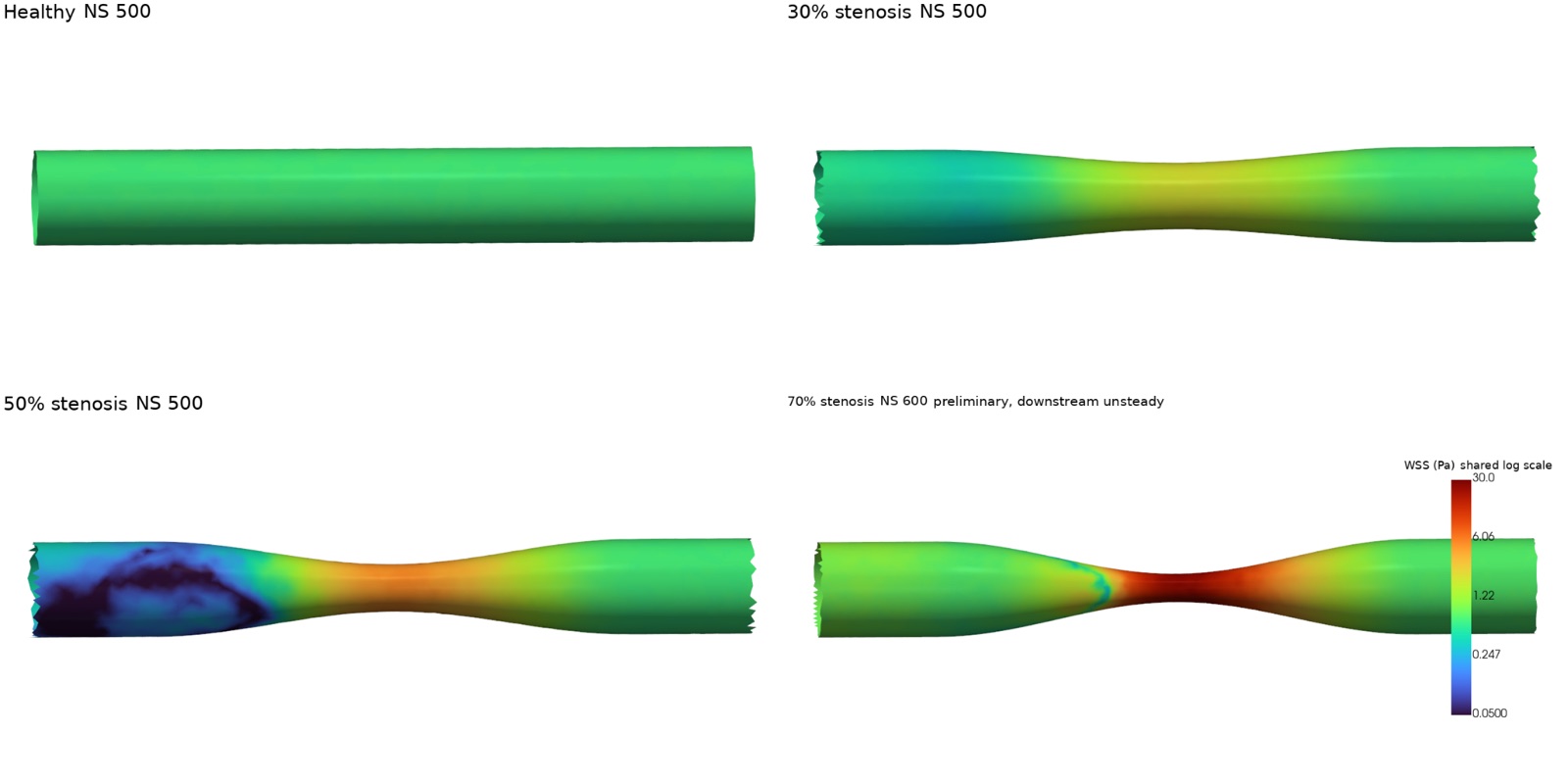
HemoDyn-AI v2 simulates blood flow through four 3D artery models, from healthy to 70% narrowed, then trains a physics-guided model to predict the flow in an artery it has never seen.
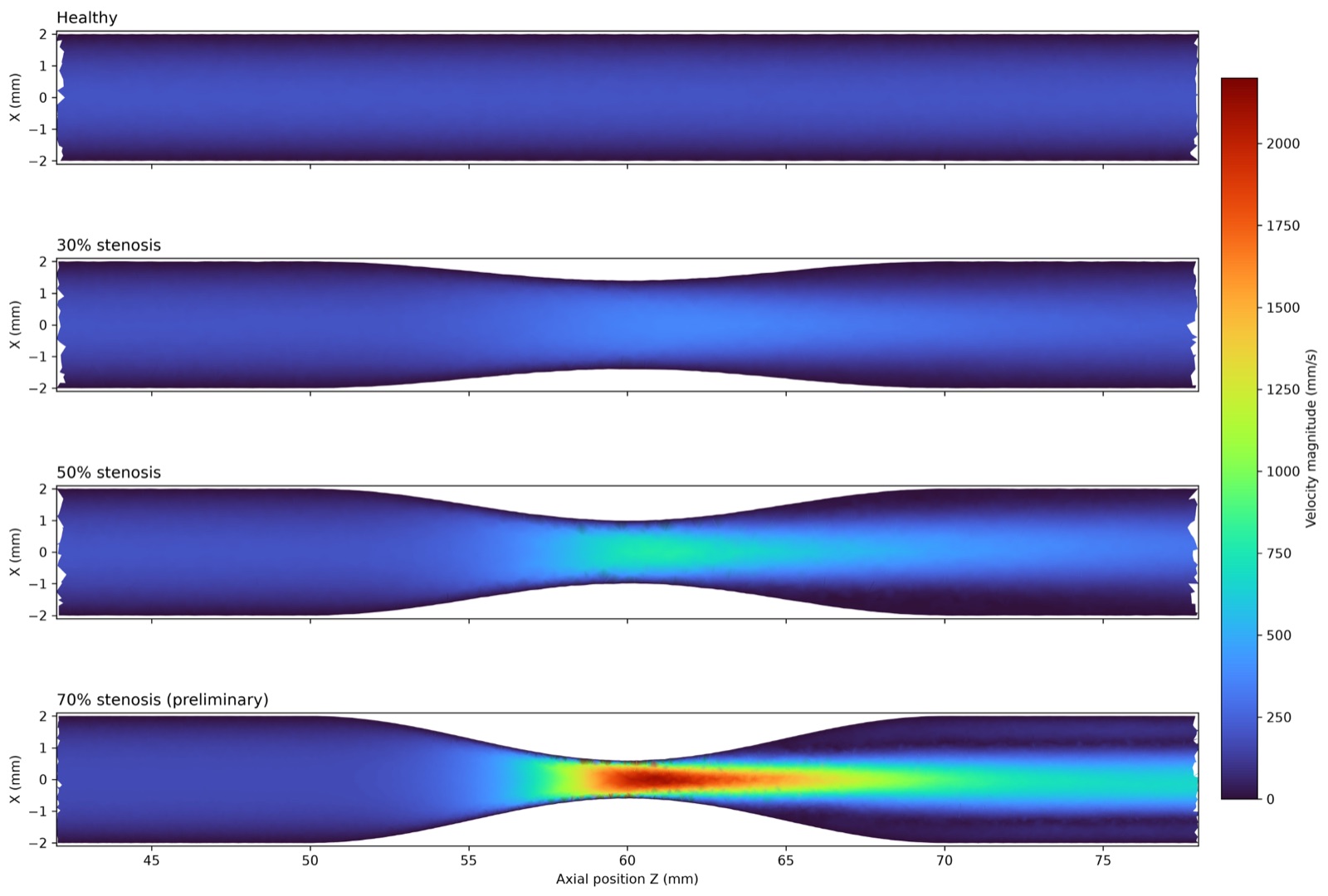
| Narrowing | Peak velocity (mm/s) | Pressure drop (Pa) | Max wall shear stress (Pa) |
|---|---|---|---|
| Healthy | 204 | 86 | 0.68 |
| 30% | 375 | 110 | 2.25 |
| 50% | 787 | 212 | 5.73 |
| 70% (preliminary) | 2,119 | 1,176 | 27.7 |
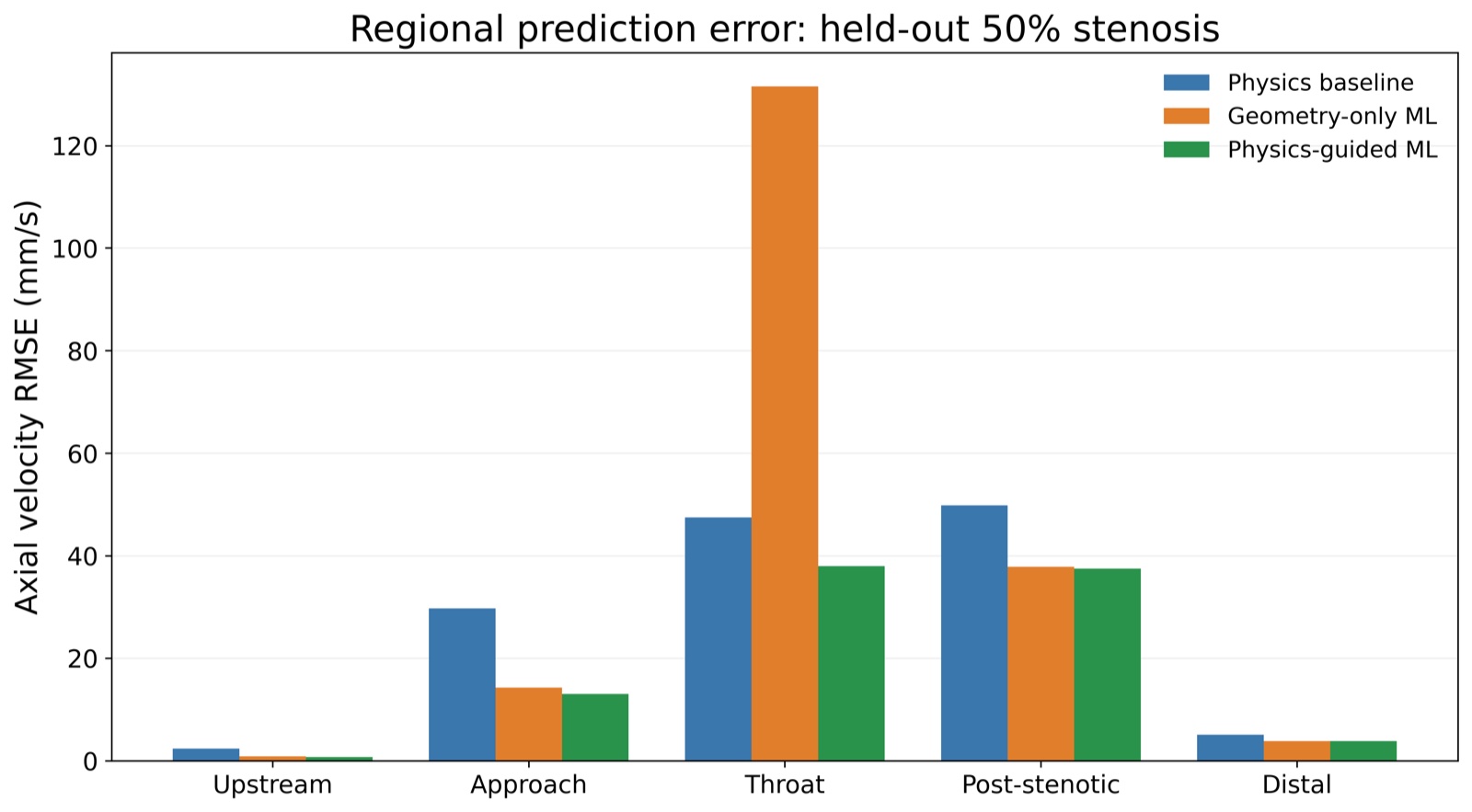
A simple flow formula gives a first estimate of the velocity at every point. A gradient-boosted model then learns only what that formula gets wrong. It trains on the healthy and 30% arteries and is tested on the 50% artery, which it never sees during training.
Across that unseen artery the error falls from 23.3 mm/s for the formula alone, and 29.2 mm/s for a model given only the geometry, to 17.3 mm/s. In the throat, where the flow changes fastest, the geometry-only model fails at 131.5 mm/s while the physics-guided model holds at 37.5 mm/s.
HemoDyn-AI is computational research. It is not a medical device and is not intended for diagnosis, treatment or any clinical decision.
qevora.cfd studies how fluids move through complex geometries using numerical simulation, and how machine learning can work alongside the physics. We build simulation and analysis pipelines that make each result reproducible.
Set up and run finite-element and finite-volume simulations, with attention to meshes, boundary conditions, and convergence.
Train models on simulation data that respect physical structure, and compare them against analytical and numerical baselines.
Explore flow in vessels and other biological geometries, where velocity and wall shear stress carry clinical interest.
We use AI assistants and models from multiple providers alongside open-source tools and our own software. They support coding, literature exploration, analysis, and iteration. Our research questions, experimental design, software integration, and evaluation give the work its direction.
Select models, software, and datasets for the question. Consider their strengths, limitations, and permitted uses.
Combine custom code and appropriate components into a focused experiment or working software prototype.
Evaluate against defined criteria, compare alternatives, and investigate errors and uncertainty.
Record methods, versions, results, and limitations so the research can be reviewed and built upon.
An illustrative research workflow: an example of how we frame a project. Specific methods and validation are defined for each investigation.
Specify the domain, fluid properties, boundary conditions, and the quantity of interest.
Generate a set of numerical solutions with documented solver settings and convergence checks.
Train surrogate models and compare them with analytical and simulated baselines on held-out cases.
Document error, uncertainty, and the conditions under which the model can and cannot be trusted.
Our work centers on experimental software and computational research, with methods and evidence that can be reviewed. Project maturity and validation are described for each artifact.
Simulation results depend on modeling assumptions and validation. Biomedical findings are computational research, not clinical guidance.
We combine AI models, development tools, and qevora’s own software to explore ideas and build experiments. Computational evaluation and review guide how we refine the work.






Logos identify tools used in our development process and do not imply partnership or endorsement. The toolkit varies by project.
We welcome conversations with faculty, research groups, medical schools, and organizations interested in a clearly scoped computational project.
Research collaborations and pilot projects.
Discuss a projectComing soon
Coming soon
Coming soon